Composition and working principle of camera module
Composition and working principle of camera module
1. Composition of the camera
The four main components of a camera are the photosensitive chip (CMOS), decoding chip (also known as digital signal processor DSP), and lens, PCB /FPC
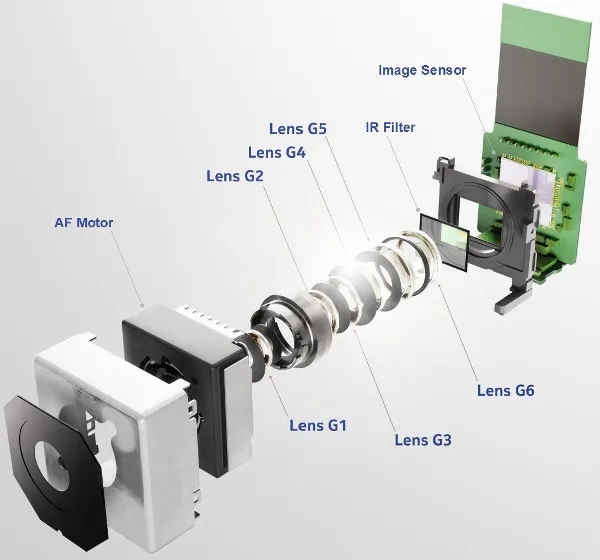
2. Working principle: The reflected light of an object is focused through a lens, and the light signal is converted into an electrical signal through a CMOS or CCD integrated circuit. Then, it is converted into a digital image signal by an internal image processor (ISP) and output to a digital signal processor (DSP) for processing, converting it into standardized MJPEG, YUV and other pattern image signals.
The lens is the soul of the camera, and it plays an important role in the imaging effect. It uses the principle of refraction of the lens, and the scene light passes through the lens to form a clear impression on the focusing plane. The image is recorded by the photosensitive material CMOS or CCD sensor. Nowadays, lens manufacturers have mainly shifted to domestic production. The lens industry, which has high optical technology content, has a relatively high threshold. Well known companies in the industry such as Fuji Seiki, Konica Minolta, Dairitsugu, Enplas, etc.
Sensor is the core module of CCM, and currently there are two widely used types: one is the widely used CCD (Charge Coupled Device) component; Another type is CMOS (Complementary Metal Oxide Conductor) devices.
Charge coupled device (CCD) image sensor, which is made of a highly sensitive semiconductor material, can convert light into charges and convert them into digital signals through an analog-to-digital converter chip. CCD is composed of many photosensitive units, usually measured in millions of pixels. When the surface of the CCD is illuminated by light, each photosensitive unit will reflect the charge on the component, and the signals generated by all photosensitive units together form a complete picture. The CCD sensor module is dominated by Japanese manufacturers, with over 90% of the global market being monopolized by Japanese manufacturers, led by Sony, Panasonic, and Sharp. CCD sensors have been unable to reduce costs due to their complex manufacturing process.
Complementary l-oxide semiconductor (CMOS) is primarily a semiconductor made of silicon and germanium, which coexist with n-level (charged) and p-level (charged+) semiconductors on CMOS. The current generated by these two complementary effects can be recorded and read as an impression by the processing chip. CMOS sensors are mainly produced by the United States, Taiwan, and South Korea, with leading manufacturers including Omnivision, Agilent, and Micron from the United States, Sharp Imaging, Genphase, and TTV from Taiwan, and Samsung and Hyundai from South Korea.
The image processing chip (DSP) is an important component of CCM. Its function is to timely and quickly transmit the data obtained by the photosensitive chip to the central processor and refresh the photosensitive chip. Therefore, the quality of the DSP chip directly affects the picture quality (such as color saturation, clarity, etc.).


 cometops
 cometops